
CNC Cutting Technology Compared
The way a machine cuts decides what it can cut, how fast, how clean the edge is and what it costs to run. Here’s how plasma, fiber laser and CNC router cutting compare, so you can match the process to your parts. ShopSabre builds all three in Lakeville, Minnesota.

Speed vs. Thickness
Each process has a sweet spot. Plasma owns thick plate, a fiber laser owns thin sheet, and a router cuts the materials neither of them can.
Thick plate, fast
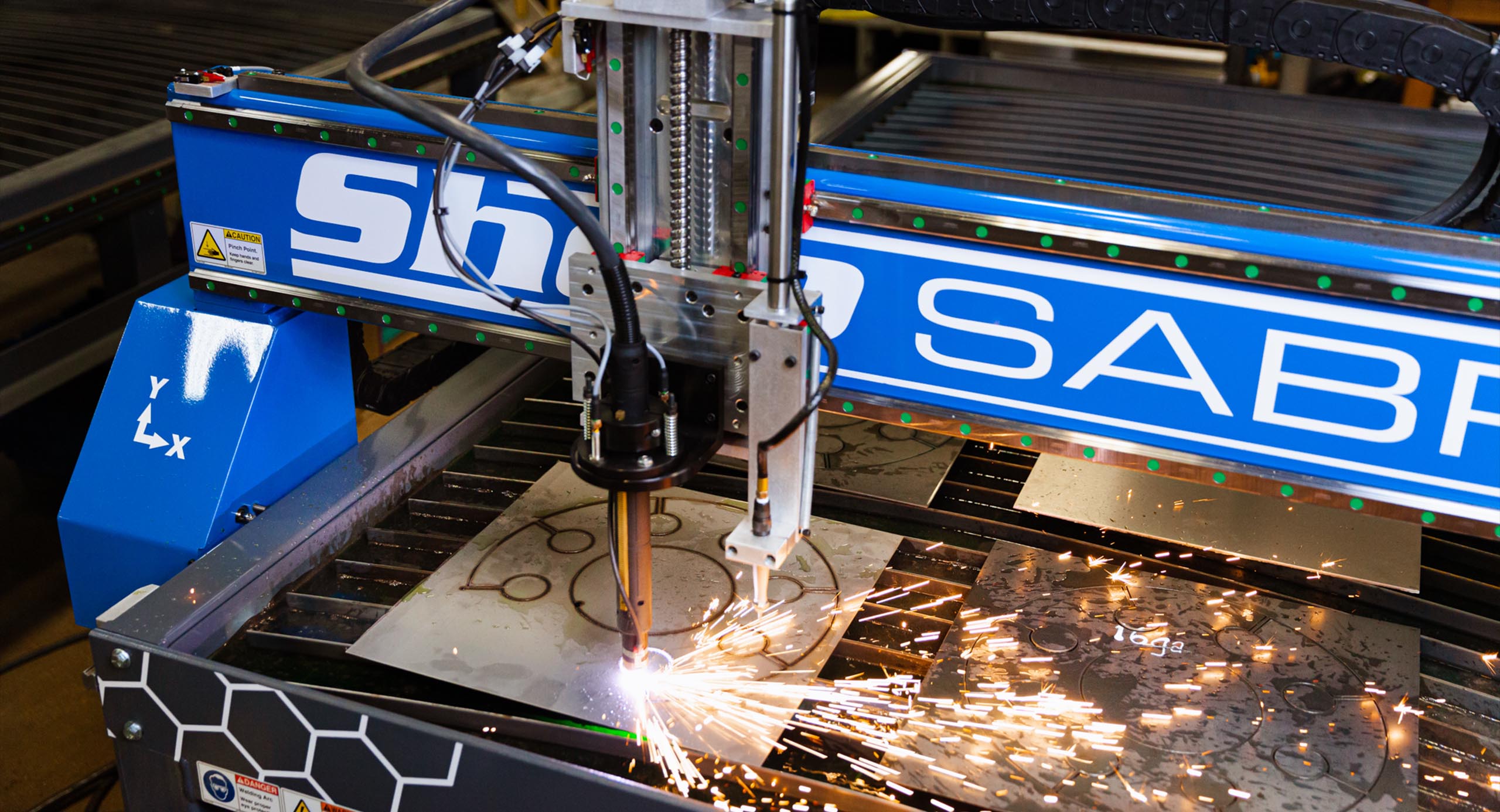
Plasma is the fastest and lowest-cost way through plate from 1/4″ up. Clean cuts reach 3/4″ on a Powermax125 and 1-1/2″ with XPR HD plasma, with severance cuts up to 6″ depending on the cutter.
Thin sheet, fastest
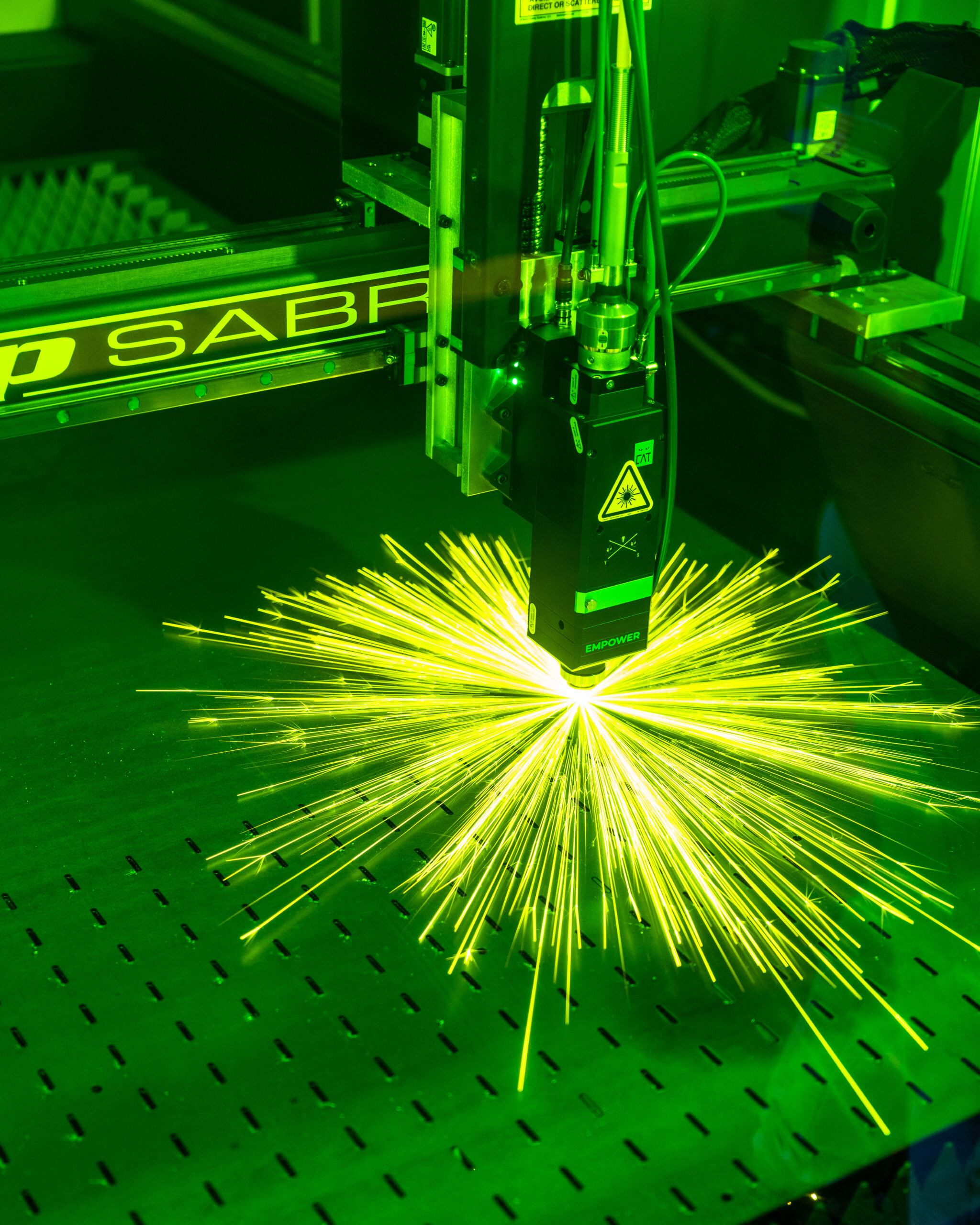
On sheet and thin plate, a fiber laser is the fastest of the three and makes finished edges in one pass. The FiberSabre cuts mild steel to 5/8″ (2kW) or 15/16″ (6kW), with 3,500 IPM rapids.
Any thickness, in passes
A router cuts sheet goods and plastics at full sheet thickness, and aluminum plate in multiple passes. Speed is set by the tool, the spindle and the material, not by how thick the material is.
Tolerance, Edge Quality and Heat-Affected Zones
How each process removes material decides the kerf, the heat it puts into the part and how much finishing you’ll do afterward.
Wider kerf, some bevel
Plasma leaves a wider kerf, a slight bevel and some dross on the bottom edge, plus a heat-affected zone along the cut. HD plasma tightens holes and edges. Parts headed for welding or paint usually need little more than a quick grind.
Narrow kerf, small heat zone
A laser leaves the narrowest kerf, sharp corners, small accurate holes and a minimal heat-affected zone, so there’s less distortion on thin metal. In many cases parts can go straight to bending, welding or powder coat.
No heat at all
A router cuts mechanically, so there’s no heat-affected zone. Edges are smooth and square on wood, plastics and aluminum; inside corners have 50% the radius of the tool.
Total Operating Costs and Material Versatility
Machine price is one line. Running costs, shop setup and the range of work you can take on matter just as much.
Lowest cost to cut metal
The lowest machine price for cutting steel. Running costs are consumables (electrodes and nozzles), compressed air and power. Needs clean, dry air and smoke control.
Highest price, lowest cleanup
The highest machine price of the three, offset by speed on thin sheet and little or no finishing. Running costs are assist gas, power, nozzles and protective lenses. Needs fume extraction and the right power.
The most versatile
Cuts the widest range of materials, from wood and plastics to aluminum and foam, and machines in 2.5D and 3D. Running costs are tooling and power. Needs dust collection and, for nested sheets, vacuum hold-down.
Each buying guide has a setup-cost calculator: plasma, fiber laser and router.
Which One Cuts What?
Pick a material to see how each process handles it.
Thicknesses are maximums for the ShopSabre machines named. Always take the right safety measures for the material you cut.
Which One Cuts What?
Pick a material to see how each process handles it.
Thicknesses are maximums for the ShopSabre machines named. Always take the right safety measures for the material you cut.
Cutting Process Comparison
Plasma, fiber laser and CNC router cutting, side by side.
| CNC Plasma | Fiber Laser | CNC Router | |
|---|---|---|---|
| Cutting process | Electric arc and plasma gas | Focused fiber laser beam and assist gas | Spinning cutting tool |
| Advantages | Lowest cost to cut thick metal; fast on plate; easy to run | Cleanest edges and finest detail on metal; fastest on thin sheet; little cleanup | Widest material range; pockets, drills, engraves and carves in 3D; no heat |
| Drawbacks | Wider kerf, bevel and dross; conductive metals only | Highest machine price; plate thickness limited by power; metals only; needs an enclosure | Doesn’t cut steel; slower on metal; inside corners keep the tool radius |
| Primary materials | Steel, stainless, aluminum, copper, brass | Steel, stainless, aluminum, copper, brass | Wood, plastics, composites, foam, aluminum, copper, brass |
| Thickness range | Gauge to 3/4″ clean on Powermax, 1-1/2″ on XPR; up to 6″ by cutter | Mild steel to 5/8″ (2kW) or 15/16″ (6kW) | Tooling and gantry clearance will dictate material thickness. Multiple passes may be necessary. |
| Speed on thin metal | Fast | Fastest | Slow |
| Kerf and edge | Wider kerf, slight bevel | Narrowest kerf, square edges | Kerf related to tool diameter; smooth, square edges |
| Heat-affected zone | Moderate | Minimal | None |
| 2.5D and 3D work | No | No | Yes: pockets, drilling, engraving, carving |
| Shop needs | Clean, dry air; smoke control; power for the cutter | Fume extraction; assist gas; single- or three-phase power | Dust collection; vacuum hold-down for nesting; compressed air |
| Repeatability (ShopSabre) | ±.002″ | ±.002″ | ±.001″ ball screw (±.002″ RC) |
| ShopSabre machines | SideKick, ShopMaster, Tube Cutter | FiberSabre 2kW, FiberSabre 6kW | ShopSabre 23, RC, PRO, Industrial, IS-M, IS-A, EVA |
| Starting price | From $18,195 | From $71,995 | From $14,995 |
| CNC Plasma buying guide | Fiber Laser buying guide | CNC Router buying guide |
Many Shops Run More Than One
The processes complement each other. ShopSabre builds and supports all three, from the same team in Lakeville.
Plasma plus routing on one table
The SideKick can add the ShopSabre router upgrade: production plasma plus light-industrial routing on one combo table.
See the SideKick →Router and fiber laser
Shops that work in wood and metal often run a router and a fiber laser side by side: the router for cabinets, signs and fixtures, the laser for finished metal parts.
Compare fiber lasers →Plasma and fiber laser
The laser takes thin, detailed parts; the plasma table takes thick plate. Together they cover gauge sheet to plate at the lowest cost per part.
FiberSabre 2kW vs SideKick →Comparing a laser and a plasma table directly? See FiberSabre 2kW vs SideKick and FiberSabre 6kW vs ShopMaster.
Keep Learning
More buying guides and comparisons from the ShopSabre team.
Not Sure Which Process Fits?
Tell us what you cut, how thick and how many parts a week. Our team builds all three and will help you pick the right one.