Plasma
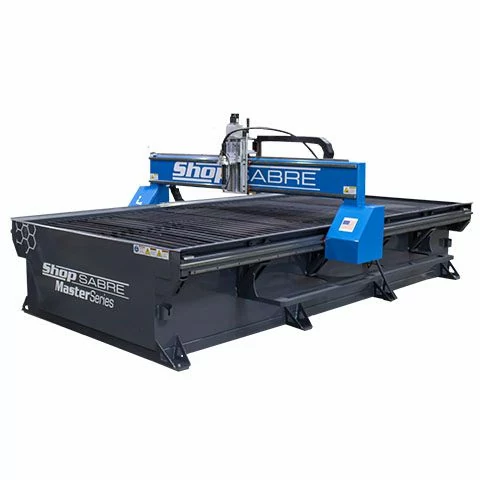
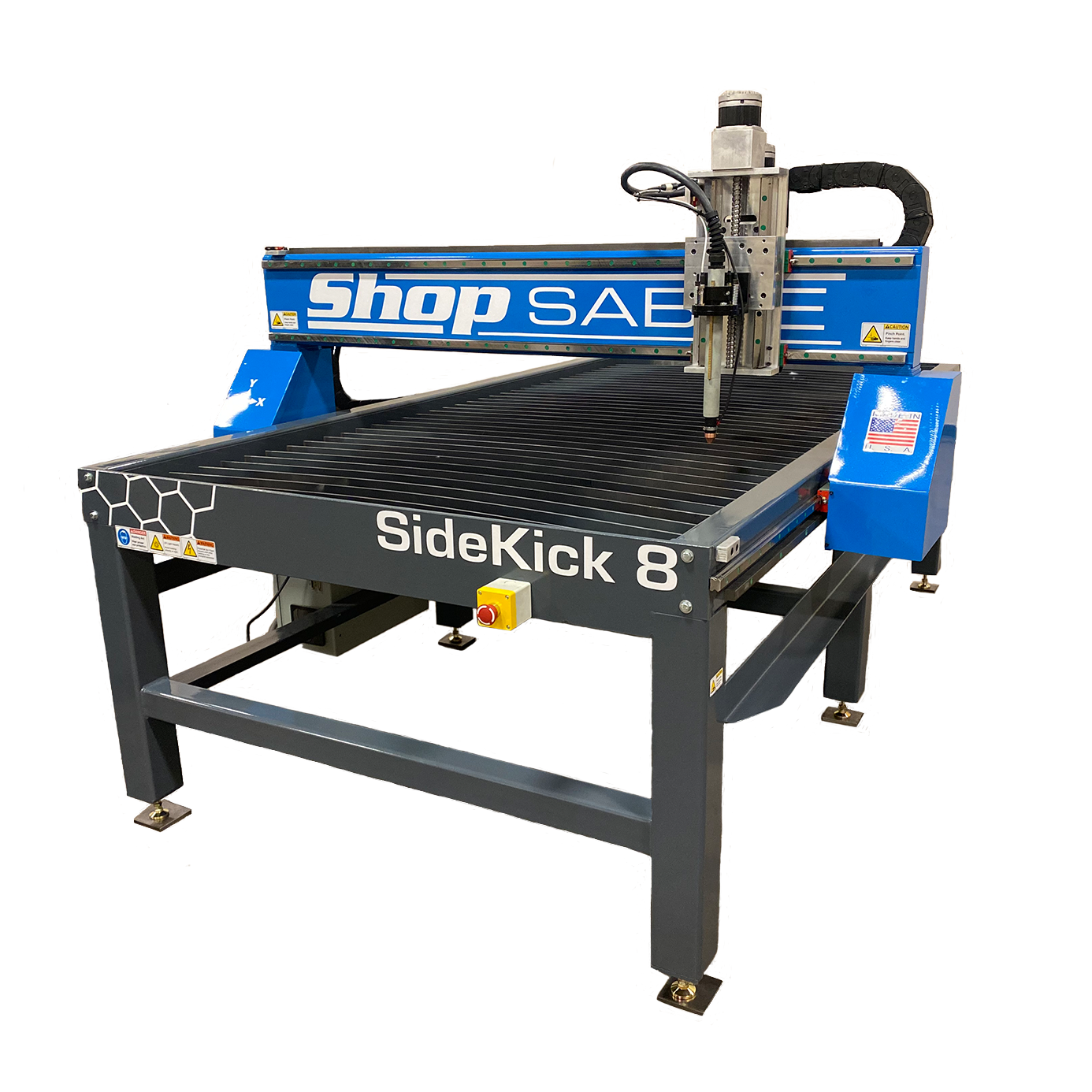
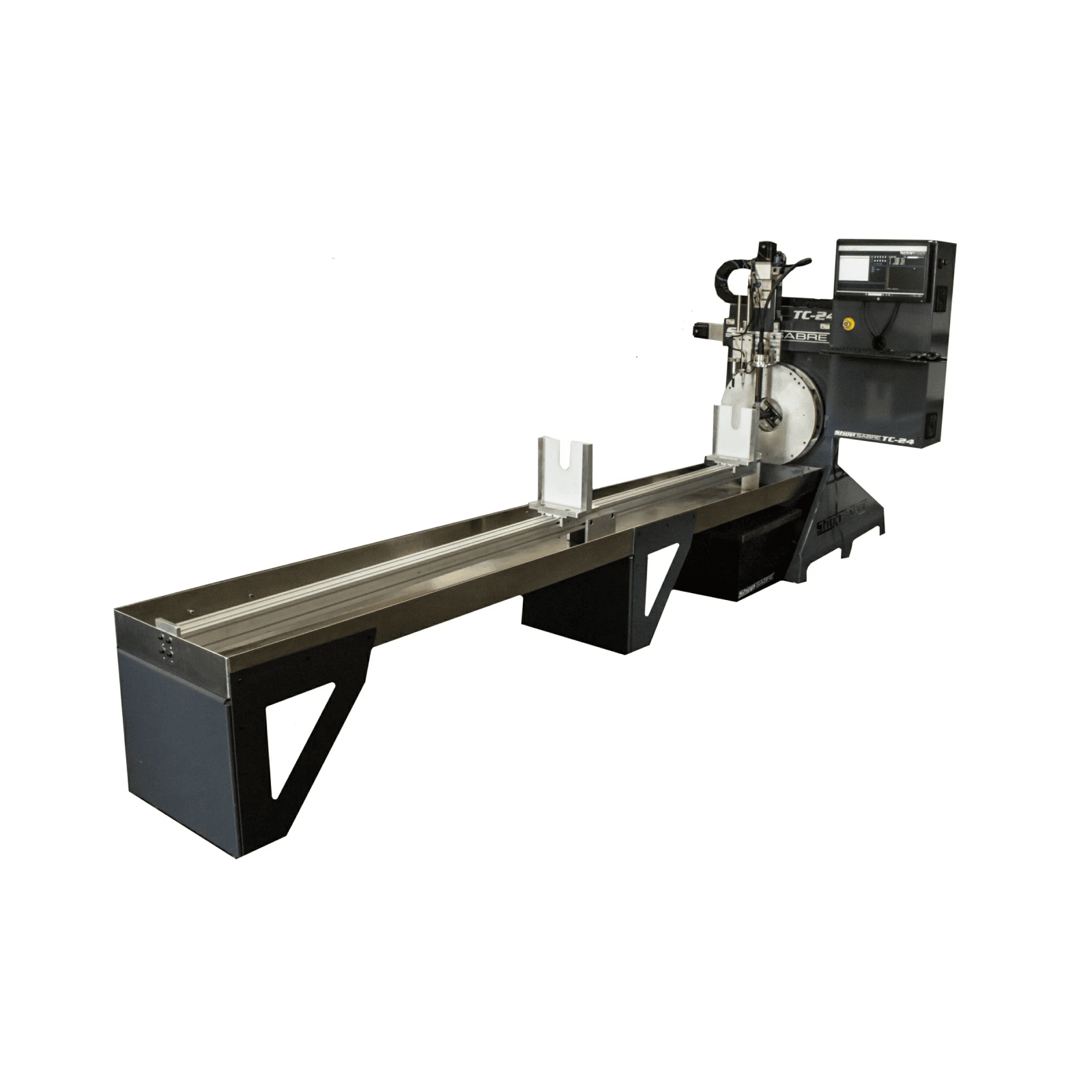
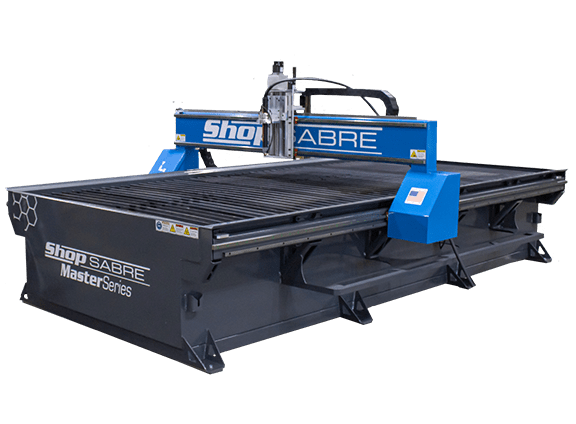
Affordable Shop Sabre Plasma Machines
are manufactured out of heavy rigid structural steel and billet aluminum,
no wimpy angle iron here or erector set frames. We use true CNC linear
rails (not roller guides) for long life and smooth friction.
Simple Installation
Complete turnkey system. Every Shop Sabre CNC Plama is fully assembled
(with exact accessories) and tested for hours before it is shipped. The
Shop Sabre CNC can be setup in as little as 4 hours from truck to shop
floor. Need to get up and running even faster? Setup and on-site employee
training available.
ShopSabre has a wide variety of plasma cutting systems available to meet
your plasma cutting needs. CNC plasma cutting has been around for more
than thirty years, but only in the past decade has it become affordable
enough for the small shop. The plasma cutting process is capable of almost
surgical precision. A ShopSabre CNC can eliminate the error of the human
hand that guides a manual plasma cutting torch which is responsible for
the roughness sometimes seen in plasma cut pieces.
ShopSabre Plasma systems are being used for:
Ornamental iron
Signs & Lettering
Art Discs
Geometric Shapes
Custom Fabrication
What type of plasma unit do you need?
The higher the amperage output of the plasma cutter, the greater the
duty cycle is at lesser amperages. If you plan to use the machine more
than six hours a day, you should consider a larger plasma unit than you
would typically use on your material. If you will be using your machine
frequently, but not continuously, consider a unit that is capable of cutting
the thickest material you are likely to work with.
Plasma Height Control Option
The plasma height control is an advanced height control system providing
exceptional performance and value for conventional plasma shape cutting
applications.
The plasma height control utilizes arc voltage sensing and microprocessor
technology to automatically detect the plate and maintain torch position
at a desired set point during plasma cutting operations. This reduces
operator input and improves accuracy, cut quality, and productivity.
See what Hypertherm has to say:
“Hypertherm's unrelenting focus has been on metal cutting technology.
With a continuous stream of innovations to improve cut quality and service
life, enhance productivity, and lower operating costs, Hypertherm products
have set the standard in the thermal cutting market.”
Plasma advantages vs. laser
Significantly higher productivity
Increases flexibility to cut a wide range of material thicknesses and
types
Significantly lower capital, operating and maintenance costs
|
Plasma provides the optimal mix of cut quality,
productivity and operating cost
|
|
Oxyfuel |
Plasma |
Laser |
|
|
|
Cut quality |
Good angularity
Large heat-affected zone Dross levels require
rework Not effective on stainless steel or
aluminum |
Excellent
angularity
Small heat-affected
zone
Virtually
dross-free
Good to excellent
fine-feature cutting. |
Excellent
angularity
Small heat-affected
zone
Virtually
dross-free
Good to excellent
fine-feature cutting with narrowest kerf |
|
|
|
Productivity |
Slow cutting
speeds
Pre-heat time
increases pierce times |
Very fast
cutting speeds for all thicknesses
Very fast
pierce times
Quick-disconnect
torches maximize productivity |
Very fast
on thin material (less than 6 mm-1/4")
and slower on thicker material
Long pierce
times on thick material |
|
|
|
Operating
cost |
Poor productivity
and required rework drive cost per part higher
than plasma. |
Long consumable
life, good productivity and excellent cut
quality drive the cost per part lower than
other technologies. |
High costs
per part due to power requirements, gas consumption,
high maintenance
costs and relatively low cut speeds on thick
material. |
|
|
|
Maintenance
Cost |
Simple maintenance
requirements can often be performed by in-house
maintenance groups. |
Moderate maintenance
requirements: many components are servicable
by in-house maintenance groups. |
Complex maintenance
tasks require specialized technicians. |
|
|
|
| |
|
Powermax specifications
|
| |
|
Powermax1000 |
Powermax1250 |
Powermax1650 |
|
Capacity
Mild steel
|
Dross free
Production (pierce)
Severance (edge starts) |
n/a
10 mm (3/8")
32 mm (1-1/4") |
n/a
10 mm (3/8")
38 mm (1-1/2") |
n/a
12 mm (1/2")
44 mm (1-3/4") |
|
|
|
Stainless steel |
Production
(pierce)
Severance (edge starts) |
10
mm (3/8")
32 mm (1-1/4") |
10
mm (3/8")
38 mm (1-1/2") |
12
mm (1/2")
44 mm (1-3/4") |
|
|
|
|
Aluminum |
Production
(pierce)
Severance (edge starts) |
10
mm (3/8")
32 mm (1-1/4") |
10
mm (3/8")
38 mm (1-1/2")
|
12
mm (1/2")
44 mm (1-3/4")
|
|
|
| Speed*
(Mild steel) |
Optimum
quality |
10
mm (3/8")
1041 mm/m
(41 ipm) |
12
mm (1/2")
991 mm/m
(39 ipm)
|
12
mm (1/2")
1447 mm/m
(57 ipm)
|
|
|
| Cut
angle |
ISO
9013 range** |
5 |
5 |
5 |
|
|
| Weldability |
|
Preparation
required |
Preparation
required |
Preparation
required |
|
|
|
Process gases
by material
(Plasma/shield) |
Mild
steel |
Air |
Air |
Air |
| Stainless
steel |
Air,
N2 |
Air,
N2 |
Air,
N2 |
| Aluminum |
Air,
N2 |
Air,
N2 |
Air,
N2 |
|
|
| Process
amps |
Not
all processes
available for all
materials |
20-60 |
25-80 |
30-100 |
|
|
* Note: Take care in comparison: competitors often show maximum cutting
speeds rather than speeds that deliver the best cuts,
as shown above. Cut speeds listed above deliver best cut quality,
but cut speeds can be up to 50% faster.
* ISO 9013 is a standard that defines cut quality of thermally cut
parts. The lower the range (range 1
is the lowest), the smaller the angle on the cut face. Cut angle in
range 4 is better than in range 5.
|
|