


Return on Equipment Investment, Cash Flow, and the Future of CNC Ownership
Written by Danny Wellens
One of the biggest lessons I learned as a business owner is that buying equipment for a business is not the same as buying something personally. We are trained to look at debt as something scary. We look at the payment, the APR, and the balance. But in business, the better question is this:
Will this piece of equipment produce more than it costs?
That is where ROI changes the entire conversation. A CNC machine is not just another expense. It is a production asset. It is a tool that can create products and open new revenue streams. When financed correctly, the machine can begin working while the business keeps cash available for materials, payroll, marketing, tooling, rent, and daily operating costs.

Equipment financing is often very different from a traditional personal loan because the equipment itself serves as the collateral. Unlike financing a personal vehicle or taking out an unsecured loan, the lender understands they are financing an asset that is designed to produce revenue. That allows equipment financing to often offer competitive terms specifically designed for businesses that are investing in growth. Business lending is different from personal borrowing as well. A personal loan is typically based on your personal credit history and Social Security number. Business financing often considers your business itself, your EIN, business history, revenue, equipment value. The goal isn’t simply lending money. It’s helping a business acquire an income producing asset.
When I purchased my own ShopSabre years ago, I assumed I would do what most people do, I was going to shop around. I figured I’d call different banks, compare lenders, and see who could beat the financing ShopSabre had offered me. To my surprise, after doing all the homework, I ended up right back where I started.
The financing option ShopSabre had presented through was hands down the best overall package I found. The rates were competitive, the terms made sense, and perhaps most importantly, they understood manufacturing businesses. They weren’t treating my CNC like a consumer purchase. They understood this machine was going to become a revenue-producing asset.
Looking back today, I appreciate that experience even more. It showed me that ShopSabre wasn’t simply focused on selling me a machine. They had already done the work of partnering with financing companies that understand our industry and genuinely look out for the long-term success of their customers. They knew that getting customers into the right financing program was just as important as building a quality machine.
Sometimes, as business owners, we assume we have to find a better deal somewhere else. Sometimes that’s true. But in my case, ShopSabre had already put me in front of one of the best financing partners available. It saved me time, frustration, and ultimately gave me financing that made sense for my business instead of simply giving me another monthly payment.
That experience changed how I look at equipment purchases. When you’re investing in a CNC, don’t just evaluate the machine. Evaluate the entire ownership experience. Financing, support, and the company’s long term commitment all become part of the investment. A CNC machine may serve your business for fifteen or twenty years. The company standing behind that machine should matter just as much as the steel it’s built from.
This also brings us to APR. Far too many people become fixated on the interest rate without ever asking the bigger question. If you’re financing a $60,000 CNC machine, a 1% or 2% difference in APR may only change the monthly payment by a relatively small amount. Yet that same machine could be producing thousands of dollars of additional revenue every month.
So instead of asking, “What’s the interest rate?” start asking, “What’s the return?”
If the machine allows you to complete jobs faster, reduce labor, and or accept work you previously couldn’t take on, that difference in APR becomes far less significant than the additional income the equipment is generating.
I’ve always believed cash flow is the oxygen of every small business.

Many business owners are tempted to pay cash because they don’t want a monthly payment. While every business is different, tying up all of your working capital in one equipment purchase can sometimes create unnecessary stress. Material costs, payroll, marketing, maintenance, unexpected repairs, and everyday operating expenses don’t stop simply because you bought a machine.
Maintaining a cash flow allows your business to continue growing while your equipment goes to work generating income. In many situations, financing allows you to preserve that flexibility instead of emptying your business account on day one.
This way of thinking has become even more important because I believe we’re entering a completely new era of American manufacturing.
I like to call it Grey Collar Work. For decades we’ve talked about blue-collar jobs and white-collar jobs as though they’re completely separate worlds.
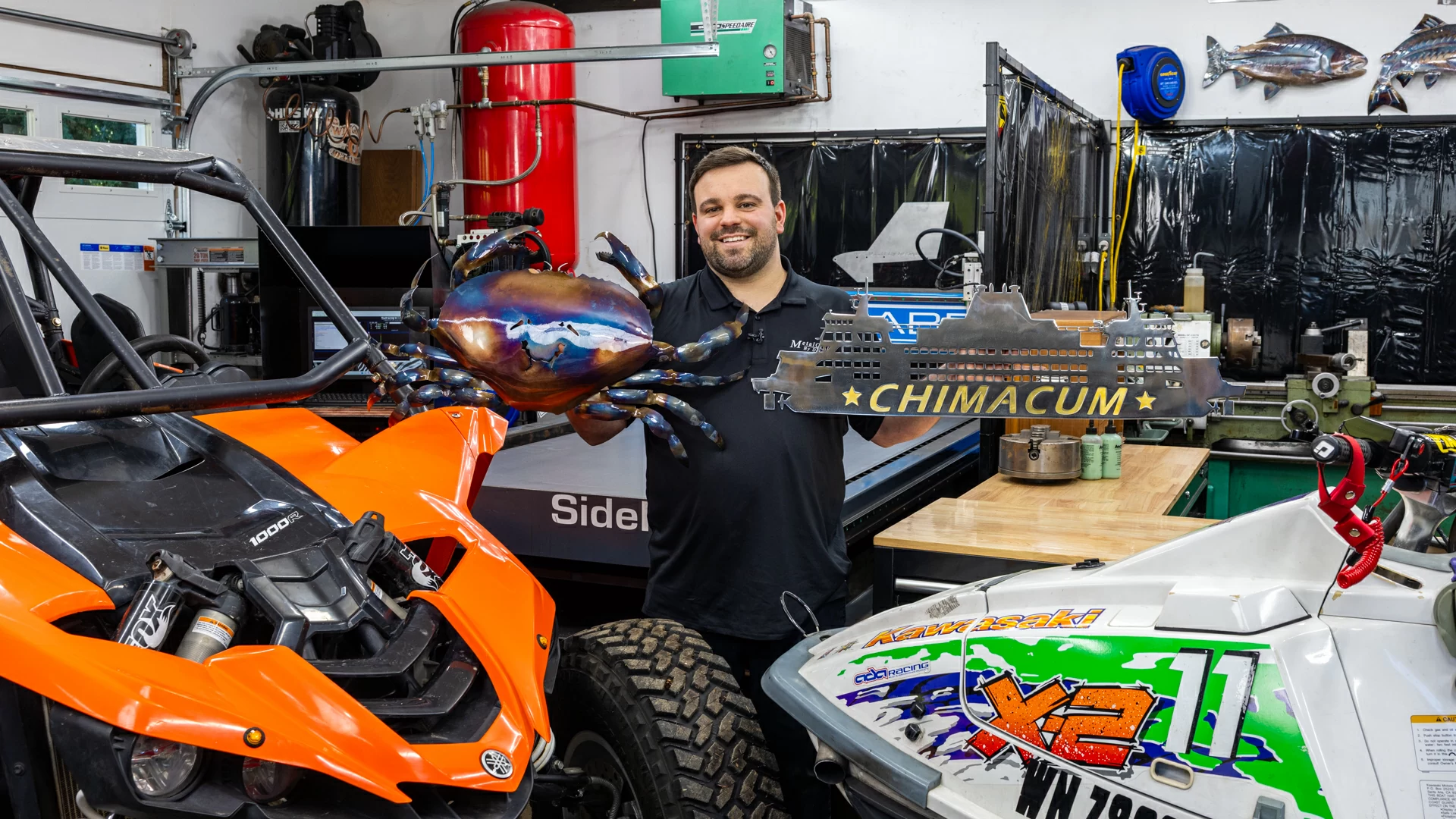
Today, CNC manufacturing blends both together. One minute you’re designing parts in CAD software, programming toolpaths, optimizing production, and using AI to improve workflow. The next minute you’re machining aluminum, cutting hardwood, engraving signs, welding fixtures, or manufacturing components for customers. You’re using technology. You’re solving engineering problems. You’re creating physical products. You’re manufacturing. That’s not traditional blue-collar work. It’s not traditional white-collar work either.
It’s Grey Collar Work.
As artificial intelligence continues changing many office based careers, we’re seeing more young people rediscover skilled trades. College costs continue to climb, while manufacturing careers increasingly combine technology, creativity, entrepreneurship, and hands on craftsmanship. Today’s CNC operator isn’t simply pushing buttons. They’re designers, Programmers, Manufacturers and Problem solvers. And often an entrepreneur building something for the next generation. That is why I believe the future of CNC automation, whether CNC Router, CNC Plasma, or CNC Fiber Laser Technology has never been brighter. Automation isn’t replacing craftsmanship. It’s amplifying it.
A ShopSabre isn’t just another machine sitting on your shop floor. It’s a business tool. It’s an employee that shows up every day. It’s a way to compete with larger manufacturers without needing a massive workforce. Most importantly, it’s an investment in your future!