
When you’re looking to scale your shop’s production, expanding your cutting capabilities is one of the smartest moves you can make. And if you’re new to laser cutting, you might be faced with the question: what is the difference between a fiber laser and CO2 laser?
The question between these two laser cutting types isn’t about finding out which machine is universally better. It’s about understanding which technology is engineered for your specific application and business.
WHAT IS THE DIFFERENCE BETWEEN CO2 LASER AND FIBER LASER?
THE SCIENTIFIC ANSWER: THE DIFFERENCE IS IN THE WAVELENGTH
When you look at how these machines actually operate, the fundamental difference isn’t the software or the gantry – it’s physics. The entire debate between fiber and CO2 comes down to wavelength and how different physical elements absorb light.
WAVELENGTHS:
In a CO2 laser, light is generated by running an electric current through a gas-filled resonator tube containing carbon dioxide, nitrogen, helium, and hydrogen. This process creates a longer wavelength of roughly 10,600 nanometers (nm).
With fiber lasers, light is generated by solid-state bank-diodes and amplified through an engineered optical fiber cable doped with rare-earth elements like Ytterbium. This produces an incredibly tightly focused, shorter wavelength of roughly 1,604 nanometers (nm).
Laser jargon aside, the difference is quite simple: CO2 lasers are like a high-output blowtorch. It throws a larger, longer wave of heat that blankets organic materials, allowing it to vaporize them.
A fiber laser is more like a concentrated pressure washer. Because its light wave is ten times smaller and more compact than a CO2 wave, it focuses energy into a microscopic point. This allows it to puncture and slice through dense, reflective metals at speeds that make a CO2 laser look like it’s standing still. It also means it’s more precise.
SOURCE OF LASER BEAM:
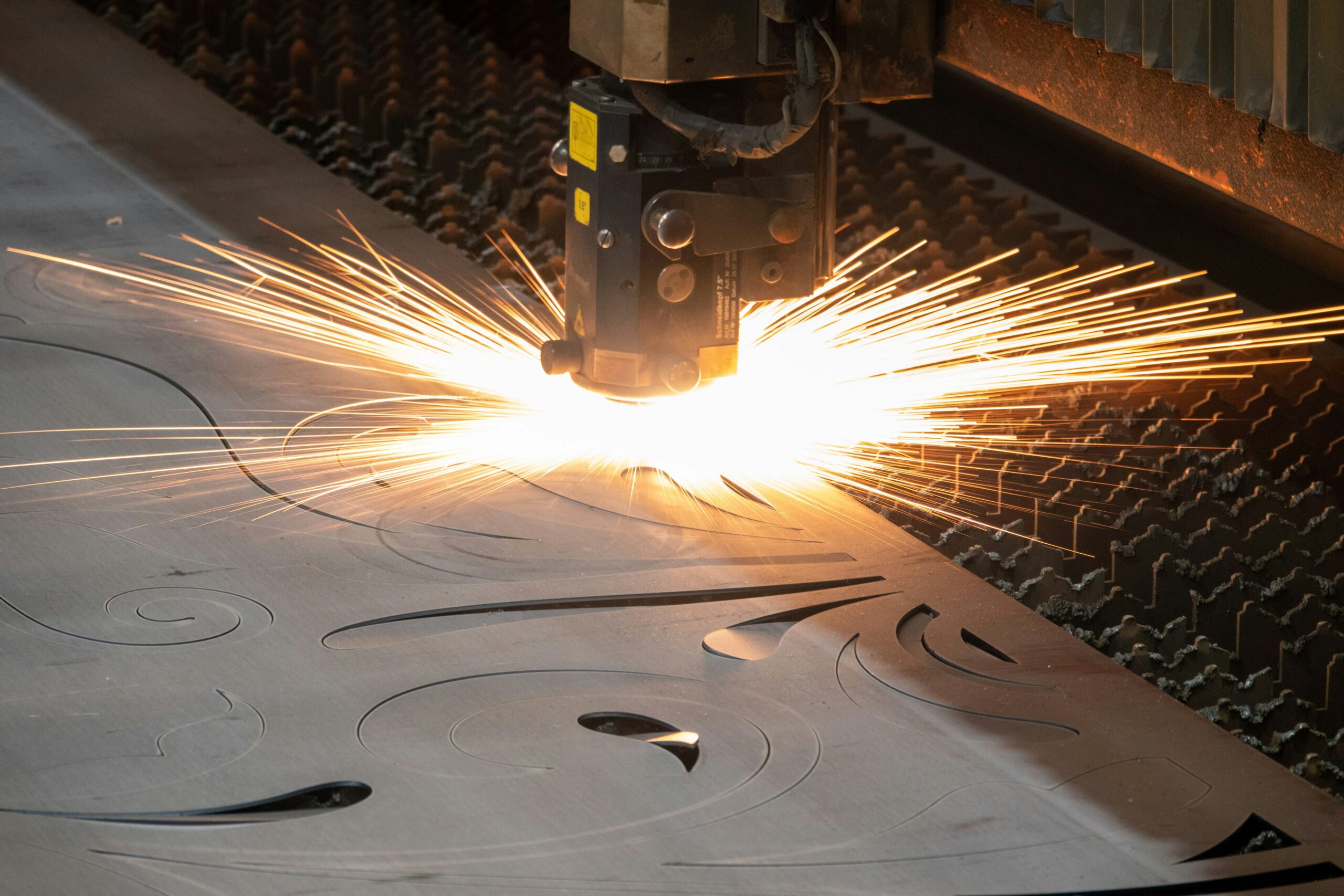
CO2 systems require a steady mixture of consumable resonator gases, a vacuum pump to maintain the environment, and a complex network of internal mirrors and bellows to bounce the beam down to the material. This means business owners must factor ongoing consumable costs into their margins and accept regular downtime for mirror cleanings and realignments to keep the beam from losing power.
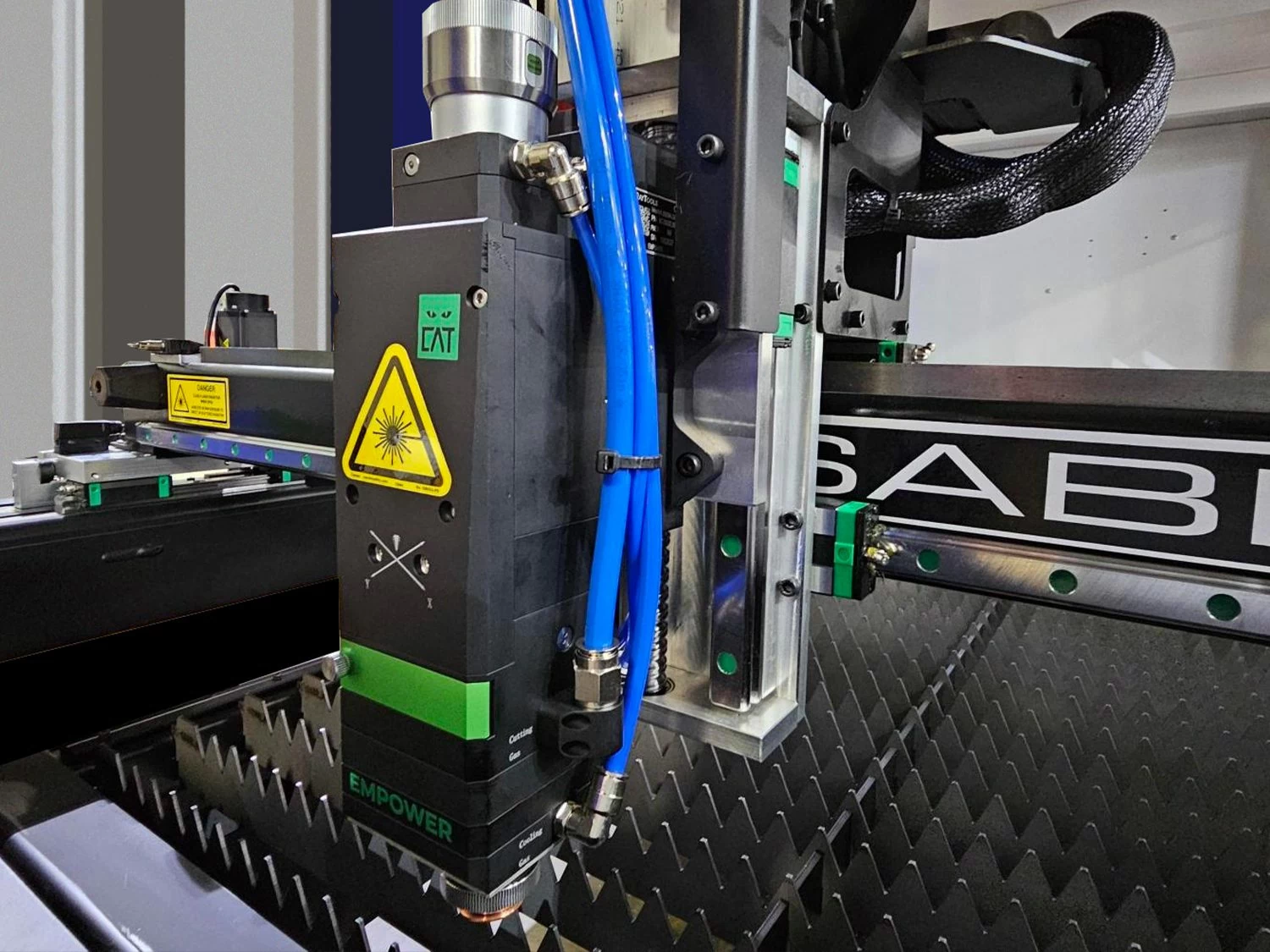
In fiber systems, the light is born in the fiber and delivered straight to the cutting head through a flexible, armored fiber-optic cable. While a CO2 laser relies on a complex path of external mirrors to guide and align the beam, a fiber laser replaces those mirrors with a flexible fiber-optic cable, though both systems still require lenses at the cutting head to focus the light. By eliminating the complex mirrors found in CO2 systems, you remove the time spent on beam alignments. You’ll still need to perform routine checks on your cutting lenses, but compared to CO2 lasers, fiber optics significantly lowers your operational overhead, reduces utility bills, and ensures your machine spends its time making parts, and revenue, every time you hit cycle start.
THE BUSINESS OWNERS ANSWER: THE DIFFERENCE IS IN WHAT THEY CUT
At the end of the day, the difference in wavelength and laser beam source only matter so much. What truly matters for your business is what each of these machines can cut. Your choice between these two platforms dictates exactly what jobs you can bid on.
Fiber lasers are purpose-built, high-speed machines for metal fabrication. The shorter wavelength’s focus allows the energy to be directly absorbed by raw metals, making it uniquely efficient at slicing through dense materials at incredible speeds. If your shop lives and dies by cutting sheet metal or processing plate work day-in and day-out, fiber is your undisputed champion.
Fiber lasers are purpose-built, high-speed machines for metal fabrication. Because raw metals absorb their shorter wavelength far more efficiently, fiber lasers deliver a massive concentration of energy that makes them uniquely capable of slicing through dense materials at incredible speeds. If your shop lives and dies by cutting sheet metal or processing plate work day-in and day-out, fiber is your undisputed champion.
- Mild / Carbon Steel: Fiber slices thin-to-medium steel up to 3 to 5 times faster than a CO2 laser of identical wattage, meaning higher volume and bigger profit margins.
- Stainless Steel: Fiber delivers razor-sharp edge quality without heat distortion or jagged dross, drastically cutting down your grinding and finishing time.
- Aluminum, Brass, & Copper: These are highly reflective which affects how the laser reacts. On a CO2 system, the beam bounces right off them and shoots back up the optics, instantly destroying thousands of dollars in mirrors. A fiber laser’s short wavelength safely penetrates these metals without back-flash.
CO2 lasers are the ultimate multi-material non-metal processors. The longer wavelength is easily absorbed by organic, non-metallic materials like wood, acrylic, fabric, and leather. If your business revolves around mixed organic materials, CO2 remains an option.
- Wood & Plywood: A CO2 laser vaporizes wood fibers, leaving beautifully dark, flame-polished edges. A fiber laser cannot absorb into wood – it will simply scorch it, char it, or start a fire.
- Acrylics & Plastics: CO2 leaves a glassy, pristine, flame-polished edge on thick acrylic. fiber lasers melt, warp, and ruin plastic parts.
- Leather, Textiles, & Glass: Essential for custom upholstery, apparel, and high-end glass engraving.
The overlap between these two technologies is thin, but it exists in thin-gauge stainless steel and specific heavy steel plates. A high-wattage CO2 laser is a much more expensive way to handle these metal cutting demands. It cuts at a fraction of the speed, requires frequent mirror and gas-mixture maintenance, and runs at triple the electrical operating cost of a modern fiber system.
CONSIDERING THE LONG-TERM TRADEOFFS BETWEEN AND FIBER AND CO2 LASER
If you are trying to scale your business, you don’t look at a machine just for what it costs today; you look at what it costs your shop every single time it fires up over the next five to ten years. Deciding between fiber and CO2 means balancing industrial speed against multi-material versatility.
PERFORMANCE: HOW DO THEY COMPARE IN TERMS OF SPEED AND CUT QUALITY?
When we talk about performance on the shop floor, we talk about throughput and minimizing secondary operations like grinding dross or polishing edges.
If you are processing sheet metal under 6mm (.25 inch), fiber lasers are no doubt the superior choice. Depending on the machine and manufacturer, running a production-grade fiber table can let you hit rapid traverse speeds of up to 3,500 IPM (Inches Per Minute). It turns concentrated energy into a tight cut width, leaving zero heat-affected zones and sharp, bolt-ready holes.
While a CO2 laser cannot match those speeds on metal, it has great quality on organics. If you cut thick acrylic on a CO2 laser, the longer wavelength slightly melts the immediate edge as it passes, leaving a polished, glassy finish right out of the machine. Fiber cannot replicate this – in fact, it would warp or bubble the plastic. On thick wood or plywood, CO2 provides a cleanly carbonized, dark edge that many sign and cabinet makers rely on for a premium look.
WHAT ABOUT THE INITIAL COST AND ROI?
Let’s be completely transparent: a high-quality, American-made fiber laser can come with higher upfront investment than a standard CO2 laser – but it’s like comparing apples to oranges. And a cheap machine that sits idle waiting for parts or constantly needs mirror adjustments is the most expensive machine you can own.
A machine like the 2kW FiberSabre starts roughly in the $67,000 range, while a 6kW production powerhouse sits closer to $100,000. That sounds like a steep hill to climb, but the payoff is driven by two things: speed and electrical efficiency.
Fiber boasts a wall-plug efficiency of 30% to 50%. Because it cuts sheet metal up to 5x faster while pulling less electricity, your cost-per-part plummets. If you have the metal volume to keep it running, a fiber laser typically pays for itself within a year by pulling outsourced laser jobs back in-house.
CO2 machines can be cheaper upfront, making them highly attractive for startups or mixed-material shops. However, their wall-plug efficiency is closer to 10% to 15%. They draw immense amounts of power just sitting on standby to keep the gas resonator ready. If you try to force a CO2 laser to do a fiber laser’s job (cutting metal), your gas, electrical, and nozzle costs will eat your margins alive.
If you’re looking to cut metal but seeking a lower price point without sacrificing quality and longevity, a plasma could be a good starting point. While a fiber laser excels at high-speed output and handling thinner cutting demands with extreme precision, plasma cutting remains a powerful tool, best suited for different applications (such as handling heavier/thicker plate materials cost-effectively). Get the full run down in our fiber laser vs plasma snapshot.
MAINTENANCE & LONGEVITY OF A FIBER VS CO2 LASER
Maintenance is where the hidden costs of a CNC machine live. It’s the difference between walking into the shop and making money – or spending your morning troubleshooting alignment issues.
Because fiber systems utilize a completely sealed, solid-state design, the laser beam never touches the open air until it leaves the nozzle. While all laser machines require consumables, a fiber system eliminates complex mirror alignments, bellows to patch, and costly resonator gases. Instead, maintenance is simplified to nozzles and protective lenses, which are significantly cheaper and faster to replace than the optical components of older technologies. Plus, the solid-state laser diode boasts a lifespan of up to 100,000 hours, giving you over 11 years of continuous, 24/7 cutting before the light source ever shows degradation.
A CO2 system demands constant hands-on care. The laser beam must bounce off a series of mirrors to reach the material. If your shop environment has dust, smoke, or temperature swings, those mirrors get dirty, go out of alignment, and lose power. You must regularly clean them, realign them, and replace them. Furthermore, CO2 glass resonator tubes have a hard shelf-life, usually dropping in performance or requiring replacement/refilling after 20,000 hours.
WHAT ABOUT DEPTH? CUTTING VS ENGRAVING
A final important distinction to make between a CO2 and fiber laser is that, beyond the materials they cut, they also perform differently when cutting or engraving.
Fiber lasers are undisputed when it comes to straight-line cutting through sheet metal and plate. However, when it comes to engraving, they operate more shallowly than a CO2 laser. Fiber doesn’t carve deep pockets into metal, but it can be used for surface etching. By adjusting the frequency, it heats the metal to create a high-contrast, permanent oxide mark (like a serial number or barcode) on stainless steel or aluminum without removing material or compromising the part’s strength.
CO2 lasers handle both cutting and engraving on organics. For cutting, they use raw heat to vaporize a thin path through wood, leather, or acrylic. For engraving, they use laser rastering, which involves rapidly firing micro-pulses back and forth to vaporize the surface layer of wood or acrylic. This leaves a clean, recessed, high-contrast mark or a deep 3D texture that feels completely smooth to the touch.
However, when your shop transitions from high-detail engraving to bulk wood production, a traditional CNC router takes the crown. While a CO2 laser is the undisputed champion for etching intricate graphics, it hits a bottleneck when trying to slice through thicker hardwoods or plywood sheets (.75 inch+) without leaving heavily charred, smoky edges. A heavy-duty CNC router physically chips the wood away with a spinning carbide bit rather than burning through it. For high-volume operations like cabinet boxes, cutting out furniture components, or milling architectural parts, the router delivers un-scorched, dimensionally perfect edges at speeds no laser can touch.
READY TO SCALE YOUR METAL FABRICATION?
If your business thrives on processing wood, plastics, and mixed organic materials, a CO2 system remains your go-to tool. But, if your shop is focused on cutting, fabricating, and nesting sheet metal, you need the raw speed and solid-state efficiency of a fiber laser.
When you make that leap, you don’t want to rely on cheap imports with zero domestic tech support. Built entirely from the ground up right here in the USA, the ShopSabre FiberSabre line is engineered with heavy-duty, stress-relieved structural steel tube frames to eliminate vibration and ensure dead-on accuracy at rapid speeds up to 3,500 IPM (cutting speeds are variable).
We offer both a highly accessible 2kW model that runs on standard 220V single-phase power as well as a high-throughput 6kW model built to tackle heavy, multi-shift manufacturing. The main difference between the two? It all comes down to speed – see our cutting speed comparison video here.
Backed by our legendary lifetime support, you are investing in a machine built to scale your business for decades. Reach out to the team at ShopSabre today to discuss your material goals, get an honest quote, and discover how fast an American-made fiber laser can transform your shop’s bottom line.