

Vacuum Technology Matters More Than Most CNC Buyers Realize
When shopping for a CNC machine, most buyers focus on spindle horsepower, automatic tool changers, cutting area, or feed rates.
I get it. But after spending years operating my own business, I’ve learned that one of the most overlooked specifications on any machine is the vacuum system.
The reality is simple. When a part starts moving during a cut, nothing else matters. If the material moves, the part is ruined. That’s why vacuum technology deserves far more attention than it typically receives.
Most CNC routers utilize one of two vacuum technologies: Regenerative blowers or rotary vane vacuum pumps. While both systems are designed to hold material to the spoil board, they accomplish that goal in very different ways.
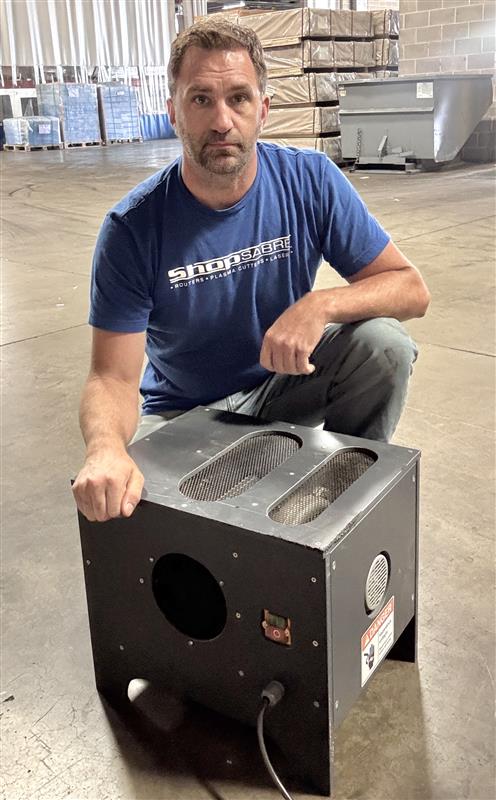
A regenerative blower is designed to move a large volume of air. Think of it as a giant fan continuously moving air through the system. These units typically generate high airflow but relatively low vacuum pressure.
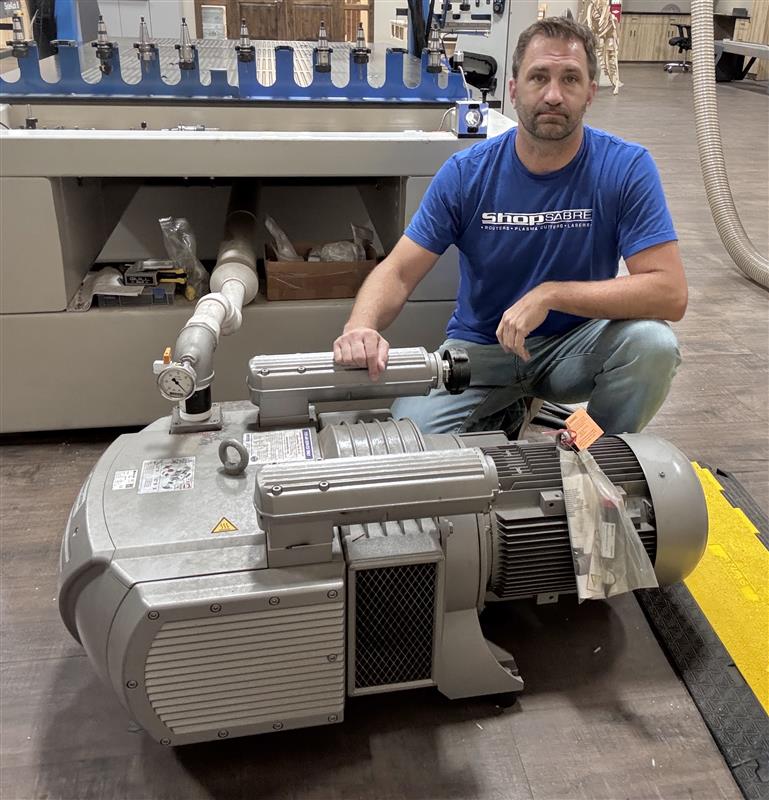
A rotary vane vacuum pump, such as a Becker system, operates differently. Instead of focusing primarily on airflow, it creates a much deeper vacuum. That deeper vacuum translates directly into greater hold-down force.
The easiest way to explain it is this, is a regenerative blower moves more air. A rotary vane pump creates a stronger grip. Both systems work. One simply creates significantly more holding force than the other.
Here’s where things start getting confusing for many buyers. One manufacturer talks about CFM. Another talks about m³/h. Another talks about inches of mercury. And others talk about millibar.
To someone researching CNC machines for the first time, it’s enough to make your head spin. I’ve seen vacuum systems advertised as producing 500, 700, or even 1,000 cubic meters per hour. Those numbers sound incredibly impressive. But airflow and vacuum pressure are two completely different measurements.
A vacuum system can move a tremendous amount of air while producing relatively little holding force. Likewise, another system may advertise a much smaller airflow number while producing significantly greater vacuum pressure and stronger hold-down performance.
I prefer looking at vacuum pressure, measured in inches of mercury (inHg), because that measurement directly relates to hold-down performance.
That’s the number that tells me how much force is being applied to the material.
Many regenerative blower systems operate around 8 inches of mercury. A Becker rotary vane vacuum pump can produce approximately 24 to 27 inches of mercury.
That’s more than three times the vacuum pressure.
The result is significantly more holding force at the table.
This becomes especially important as parts become smaller. Anyone can hold down a full sheet of plywood. The real challenge comes after you’ve cut the sheet apart. That’s when vacuum performance starts to separate itself.
On my own ShopSabre IS510, I run the F4 regenerative vacuum system. Overall, it performs very well. When I’m processing larger sheets, the system does exactly what it’s supposed to do. But years of operating CNC equipment have taught me something important:
The challenge isn’t holding down large parts. The challenge is holding down the last few parts left on the sheet. As parts become smaller, the amount of available surface area decreases. As surface area decreases, holding force decreases. T
hat’s simply physics!
Every CNC owner eventually reaches that moment where they’re watching a small part during a finishing pass and hoping it stays exactly where it belongs.
That’s where deeper vacuum becomes a tremendous advantage.
There is another consideration that rarely gets discussed during the buying process.
Noise! Regenerative blowers are loud. Anyone who has spent an entire day standing next to one knows exactly what I’m talking about. The high-pitched whine becomes part of your daily work environment.
After years around CNC equipment, I’ve simply gotten used to it. But that doesn’t mean I enjoy it. Many regenerative blower systems operate somewhere in the 80 to 90 decibel range. Becker rotary vane pumps often operate significantly quieter, commonly falling closer to the 65 to 75 decibel range depending on the model and installation.
That difference may not sound dramatic on paper. But decibels don’t work in a straight line. A reduction of 10 decibels can be perceived as roughly half as loud to the human ear.
The difference is immediately noticeable!
Instead of the high-pitched scream associated with regenerative blowers, rotary vane pumps tend to produce a lower, more subdued operating sound.
Vacuum performance matters but in my opinion, operator comfort matters too.
One of the things I enjoy most about being involved in the CNC community is hearing real-world experiences from machine owners. I spend a lot of time reading discussions in owner groups, forums, and online communities. One theme seems to come up repeatedly.
Many owners who started with regenerative blowers say that if they were making the buying decision again, they would strongly consider a Becker rotary vane system.
Not because the regenerative blower failed. Not because it doesn’t work.
But because stronger vacuum makes life easier and confidence matters when your livelihood depends on what comes off that machine.
The Bottom Line!
The next time you’re comparing CNC machines, Ask what the number represents. Ask whether you’re looking at airflow or vacuum pressure.
Ask how the machine performs when only a handful of small parts remain on the table. Ask how much noise you’ll be listening to for the next ten years.
Because in the world of CNC manufacturing, bigger numbers don’t always mean better performance. Understanding what those numbers measure is what separates an informed buyer from an overwhelmed one. And sometimes, the difference between a successful cut and a ruined part comes down to one simple question:
How well is your vacuum system holding your material to the table?